
This is Your Brain On Scarcity

You are not as good a coach at 5:00 pm as you are at 9:00 am. You are not as good on a Thursday when you're three clients behind on programming as you are on a Monday when you're caught up. And you are measurably, demonstrably, scientifically worse in a session with someone when you're worried about making rent.
But you knew that already.
What you might not know is that what I’m describing has a name, a mechanism, and a body of research that makes "you're a little tired" look like the most aggressively useless diagnosis since bloodletting (which, by the way, they did for two thousand years, so maybe pump the brakes on assuming we always know what we're doing, but that's—you know what, we're getting off track).
One of the best books I read last year is Scarcity: Why Having Too Little Means So Much by Sendhil Mullainathan and Eldar Shafir, a behavioral economist and a psychologist who spent years studying what happens to human cognition when people don't have enough of something.
Their thesis is that when you don't have enough—time, money, attention, food, whatever, it barely matters what—your brain locks on the scarcity like a golden retriever on an unattended charcuterie board, and everything else loses cognitive resources. They call it reduced bandwidth.
Talk Bandwidth to Me
Bandwidth has two parts:
Cognitive capacity: Your ability to solve novel problems, reason through things you haven't seen before, do anything that requires actual active thinking rather than just running a protocol you already have memorized. This is the thing you use every single minute of every session.
And
Executive control: Your ability to direct attention, manage impulse, and plan more than four minutes ahead. Also the thing you use every single minute of every session. You see where this is going.
And both get absolutely torched when you're feeling scarcity.
In fact, Mullainathan and Shafir ran people through fluid intelligence tests—which is just researcher-speak for "how good are you at thinking right now"—after priming them with either a mild or stressful financial scenario. "Hey, imagine you have a car repair bill," they said and then gave the tests. The group who got the stressful version scored 13 to 14 IQ points lower.
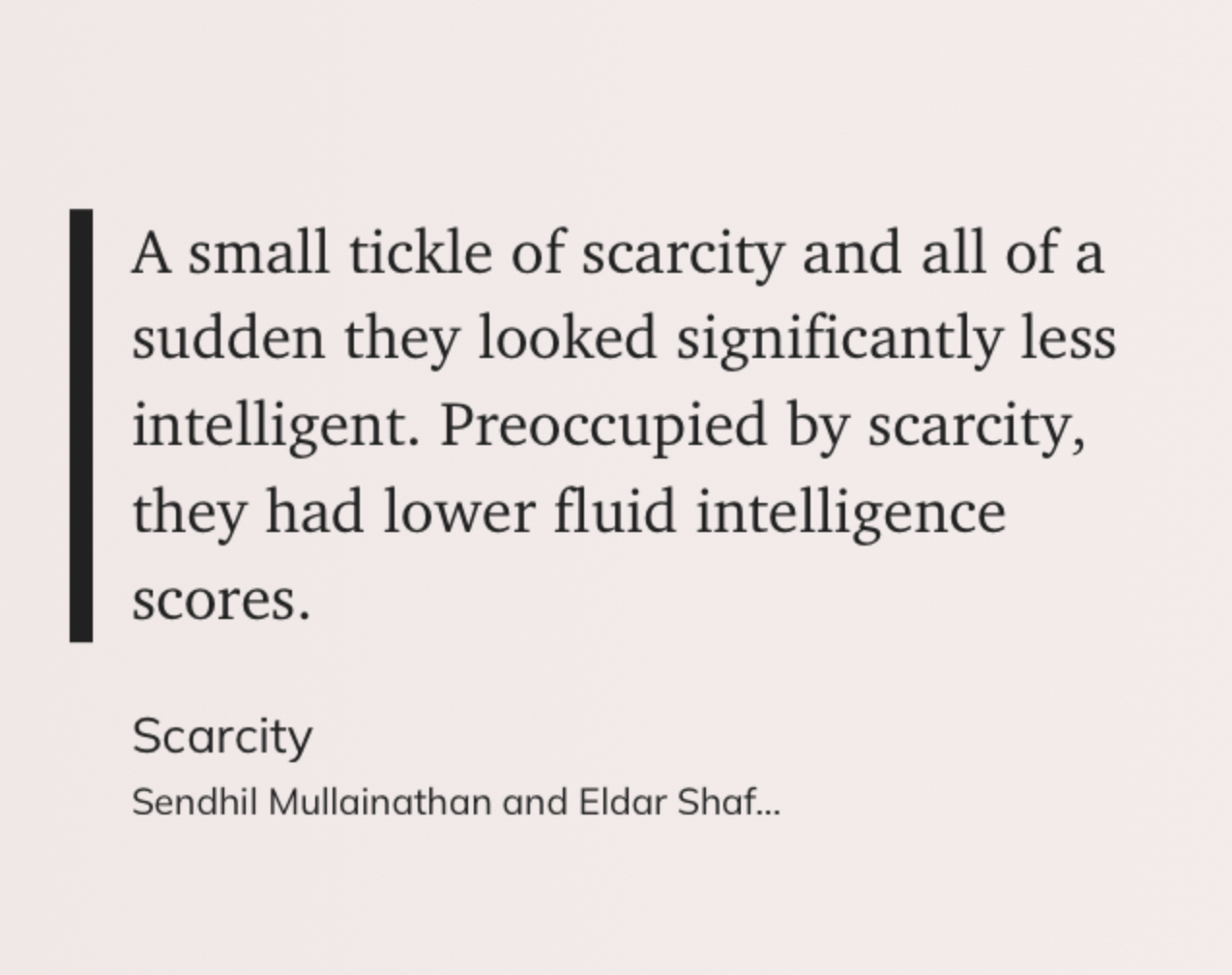
That fake car repair bill produced a bigger cognitive drop than going a full night without sleep! Functionally lobotomized by a hypothetical Honda Civic! Fuck overwhelm, that's a measurable reduction in the quality of your thinking.
Now, replace that Civic with four clients back-to-back, forty minutes behind, one passive-aggressive text from someone whose rate you haven't raised in three years, the prep you were going to do at 7am that you did not do at 7am, and the very real ambient knowledge that you cannot afford to lose a single client. And that's just your Tuesday. How well do you think your brain is doing?
Scarcity in Coaching
Now think about what this job actually requires.
Unlike almost any other skilled profession, coaching doesn't have a procedure that carries you when your thinking goes soft. Pilots have laminated checklists. Surgeons follow protocol. Accountants have, I don't know, spreadsheets and a load-bearing belief that numbers should add up.
But YOU have a person in front of you. An actual, specific, unrepeatable person who who does not match the last person, who is going to walk in presenting in a way you could not have predicted, and your job—everything you're billing for—is to figure out, in real time, what is actually happening and what to do next.
That is one hundred percent fluid intelligence.
And that is exactly what scarcity takes first. It goes straight for the good china.
When you're short on time, you run the recipe, the move you've coached a hundred times, the cue that's always within arm's reach. Is there a better answer? Probably (and you will think of it approximately twenty-two minutes after the session ends). But generating alternatives takes bandwidth you don't have, evaluating them takes more bandwidth you also don't have, and so you—
I'm not going to say "go through the motions." I'm not going to say it.
...You go through the motions.
When you're short on energy, the diagnostic work goes shallow. You're watching but you're not seeing. It's more like pattern-matching—this looks like that, I know what to do with that. Maybe the session is fine. Maybe it isn't fine. Either way, you're out of brain juice and the clock is chewing through minutes and there's another person waiting.
And when you're short on money, your clinical judgment may start bending toward keeping the client rather than telling them the thing they need to hear, toward softening a recommendation, as the session reorganizes itself around the economics of the relationship. Or you completely fry yourself by trying to squeeze in more clients (or find new ones) to cover the bills.
This is your brain on scarcity.
The thing that makes this especially fun—and by fun I mean bleak—is that coaches are routinely running all four simultaneously, which means you are not merely experiencing scarcity. No, no, you are stacking scarcity like a sociopathic barista of cognitive impairment, layering shot after shot after shot of reduced bandwidth.
And you know what? Most coaching business models are basically architected to produce scarcity conditions. Think about it. Back-to-back sessions because the math doesn't work any other way. Client loads sized to what the bills require rather than what the work requires. Little to no margin. Little to no downtime. It’s insanely hard to develop your own skills, because development is always the thing that gets deferred until there's time, and there is never time, because if there were time you'd fill it with a client because you need the money because you have no margin and—
The good news is that Mullainathan and Shafir's central argument is that scarcity is a conditions problem. So it's not a you problem, or a discipline problem, and DEFINITELY not a "try harder and also have you considered a better morning routine" problem. The same person performs measurably differently depending on whether the conditions are present. Remove the conditions, and performance returns, the IQ points come back, and your prefrontal cortex gets back to work.
Which means the lever isn't effort. It's the conditions themselves.
And conditions can be changed.
What those conditions look like inside a coaching practice, and how to actually change them, is what I'll be writing about this month. Over the next few posts I'm going to walk through the types of scarcity we face most often and what it's doing to your work.
We'll start with time scarcity, the tunnel, why you keep running the same plays on your stuck clients, and why the better answer arrives twenty minutes too late every single time.
Then attention scarcity, which is a different problem than time and in some ways worse, because you can have the hours and still not have the cognitive quality to do anything meaningful with them, which is its own special category of bad.
Then what happens when both go unaddressed long enough and the whole thing becomes self-reinforcing—which is a nightmare.
Then money scarcity, the scarcity that seems to rule all the other scarcities, the scarcity Sauron.

“Your dog ate something stupid and needs to go to the vet.”
If you just did the math on your own workday and arrived at "gahhhh, my job is a perfect shitstorm of all four, that's the schedule I built and agreed to and cannot currently see a way out of—" Good. Good. That is the correct reaction.
Start paying attention now. Clock when your thinking is genuinely sharp versus when you're running on habit and momentum and a protein bar from 2024. Notice what you reach for when you're low on minutes and brain juice. Notice whether you're actually responding to what's in front of you or managing around a client relationship the rent depends on.
You’ll have a head start on my next post.