
The Dysfunction Hiding in “Functional” Movements
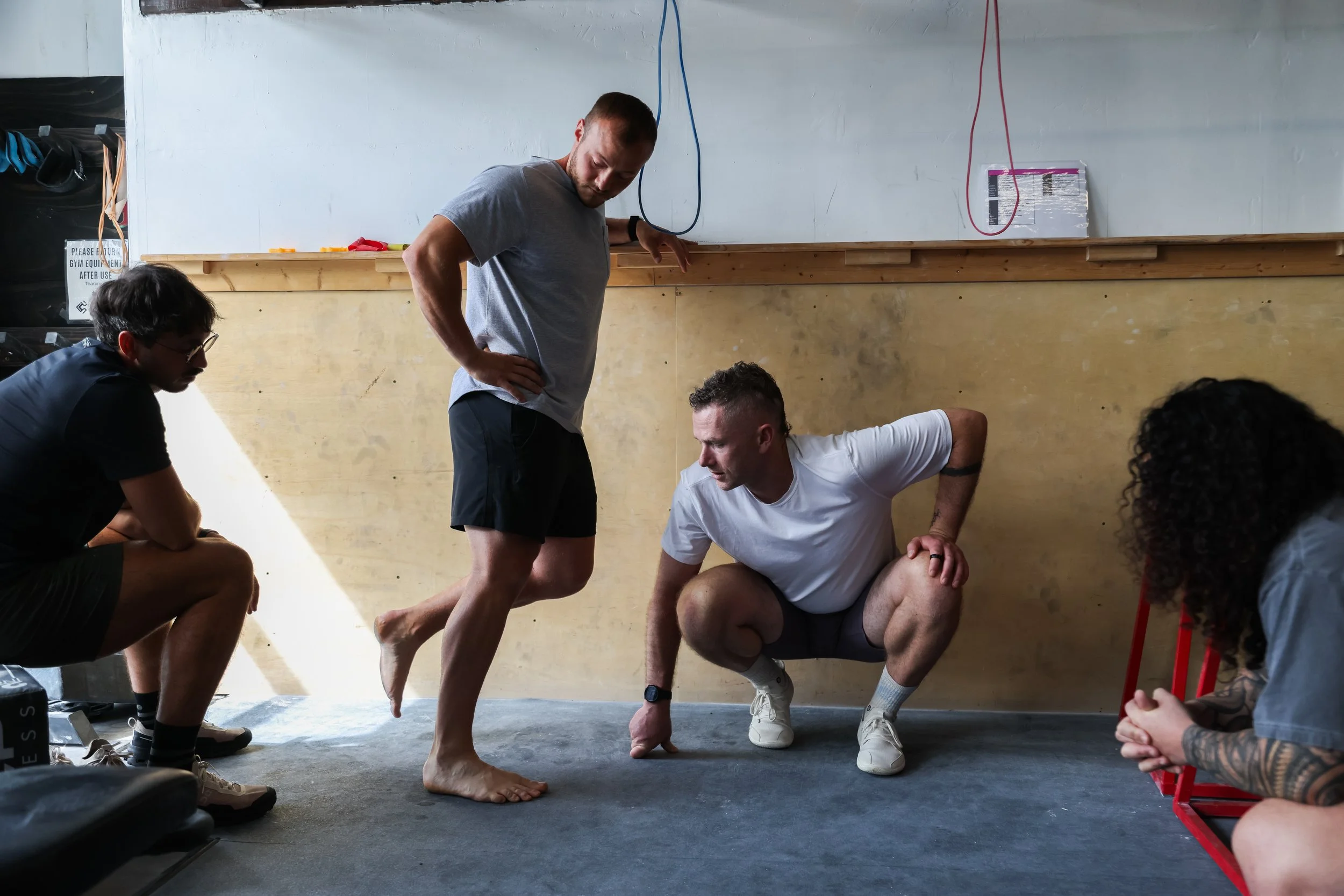
You should probably stop squatting so much.
More and more these days, I find myself telling clients, “You need to isolate joints and muscles, bodybuilding style.” Just yesterday, I told someone who does competitive Olympic weightlifting that she’s weak and has neglected her quads.
Now, how could that be? She’s been doing heavy squatz ‘n’ stuff. Deadlifts. Bulgarian thingamajigs. You know, the fundamentals. Things that are in everyone’s programs and are supposed to make you big and strong.
And yet! Her quads are weak. She did all the movements that should have built them, but they didn't. Which means somewhere between "squat goes down" and "squat comes up," her quads stopped being part of the equation—and she never noticed, because the weight kept moving.
If you think compound movements are the best thing you can do, you’ve drastically underestimated how complex the body is.
To stand up from the bottom of a squat, you have seven muscles plantarflexing your ankle (plantarflexion in a squat means your knee goes backward), four quad muscles extending your knee, and extending your hip are a few hamstrings, one glute, and a huge adductor that everyone thinks only does adduction, but its primary purpose is hip extension.
That's fifteen muscles, all supposedly working together. If you assume they're all actually doing their job when you stand up, you've made one of the biggest and most common mistakes in the industry—because that's not how complex systems work.
Complex systems don't need every part to participate. They find different ways to solve the same problem, and your body will use whichever solution is easiest. This has a name: degeneracy. I talk about it a lot, and I’m going to explain it here with a simpler movement: standing on one leg. You can do it in at least three ways:
You can shift your weight over, everting your ankle and adducting your hip. (These structures are well-suited to those movements.)
You can side-bend your spine enough to shift your center of mass to balance over your center of pressure, your foot.
You can bring your knee in, under your midline. It looks like a valgus collapse, and it is, but it still does the job.
Three solutions to one problem, but only the first pattern is sustainable, because it uses structures that evolved for those movements and their respective forces. The other two get the job done, but they load structures that weren't designed for it. Keep using them, and those structures will eventually let you know.
The Illusion of the Loaded Squat
Let’s return to the squat. See, people can stand up using all or only some of those fifteen muscles. Your brain doesn’t care which. It just wants to stand up. So during a squat, you can extend your knee without using your quad very well. You can plantarflex without using your calf. If you think I'm crazy, you're taking movement for granted.
Here's what it looks like when the quad checks out: your adductors and hamstrings drive hip extension hard enough to pull the whole system up. And when the hip extends while the foot is fixed to the ground, the knee has to extend — it's geometry. The quad's job is to drive that knee extension. But if hip extension is doing the work, the quad just comes along for the ride. One part of the system is coasting while others pick up the slack, and every rep reinforces the workaround.
So what do you assign the Olympic-lifter-client with the weak quad? Almost anything that forces the quad to work. You have to isolate it, though, reducing movement options like you’re eliminating escape routes. You need to create a situation where the brain has to send a signal to the quad because it's the only option left.
That could be a reverse Nordic, a half-kneeling squat—hell, sitting on a knee extension machine at the gym is a splendid choice. Maybe it’s one of those plus forty-five seconds of continuous work. What you can’t do is just tell someone to squeeze their quad harder when they stand up. Nope.
Conscious intention operates at a different level than motor pattern selection. By the time you think "squeeze my quad," the brain has already picked its movement strategy. You can't out-think a compensation that's been running on autopilot for months or years; you have to structurally remove the option to compensate. Corner the brain so the only way out is through the muscle you're targeting.
Now, this might sound like an "activation series." It's not. I avoid that term because everything that follows in the wake of "activations" is usually too generic, light, and short-lived. This is different: you find the specific weak link in this person's system, you load it heavy enough to build real capacity, and you sustain it long enough to actually change the pattern. You need to train the fuck out of these movement substitutions to have a chance of changing such a complex system.
The Glute Problem
Complex systems, in short, are things that are greater than the sum of their parts. Sometimes those parts are fucked. Your job is to discover which part of many is fucked—it might be multiple parts—and then unfuck them. One way to unfuck a system is to disassemble the thing into its individual components, test them, find the part that's actually broken, improve just that part, and then reinsert it into the complex movement, like a squat.
If you're nodding along and patting yourself on the back—"Yeah! That's why I assign so much glute work. Gotta wake up those asleep glutes!"—I hate to break it to you, but you're wrong.
Actually, I don't. It's easy for me to break it to you. What I hate is bad thinking. And perpetually blaming glutes for problems they didn't create is really, really bad thinking.
God, it’s so bad.
"It's probably glutes" skips evaluation. The method is supposed to be: test, find the weak link, train the weak link. Defaulting to glutes skips steps one and two. You're not diagnosing, you're just reaching for the most popular answer. Sometimes you'll be right, but often you won't. And you'll never know the difference, because you never tested in the first place.
What’s worse is that you’re smarter than that. Most people are; they just haven’t been taught the right principles. Your clients and your business deserve better thinking.
Don't get it twisted. I'll tell you three times: this isn't about some "activation series" for an "asleep" muscle. (Muscles aren't narcoleptic.) This is about solving complex problems. And sometimes those solutions require isolating an individual part, doing way more than activating it. You're giving it the capacity it needs to match the rest of the system.
What kind of capacity? Well, that depends on what's missing—which you'd know if you tested. Maybe it needs strength, or endurance. Maybe power, speed tolerance, or more variability.
Strike "Functional" From Your Vocabulary
This is why the whole "functional movement" label is broken. It assumes that compound equals complete, that if a movement looks like real life, then it must be training everything it's supposed to train.
But we just spent this entire post establishing that's not true. Compound movements can hide massive gaps and let weak links coast for years. So calling something "functional" doesn't mean it's actually functioning.
At the end of the day, and the end of this post, functionality isn't whether or not a movement looks like something you do in daily life. I don't even know what functionality is anymore, but I know what it isn't. It sure as hell isn't a shoulder press, squat, deadlift, or plank.
I've spent enough time writing, rewriting, and deleting attempts at defining functionality, and the only conclusion I've arrived at is omission. The word itself is the problem—once you call something "functional," you've already assumed it's working. The label gives you false confidence. It lets you stop looking. So just strike "function" from your vocabulary. You'll be better off.
You don't need to stop squatting, I suppose. Just stop thinking that it's some ultimate movement that ticks all these boxes. Do not take movement for granted. Your brain's organization of movement is far too clever for such reductionist thinking.